Rao, Slok & ANT Magic Pudding
Three documents landed between 24 and 26 October: Apollo chief economist Torsten Slok's note on AI's missing payoff, Venkatesh Rao's essay "Cognitive Mercantilism", and Anthropic's S-1. Read together, they settle an argument. Slok is a man sitting in a gold mine, complaining about the dirt.
The bound on AI's economic payoff today is physical: fab, memory, power, helium. It holds through 2030, and very likely well beyond, because people keep finding uses for cognition. For now, intelligence is a magic pudding.
The bear: zero payoff outside tech
Slok's claim is stark. AI has delivered "zero financial payoff to corporate America outside of tech." Revenue per employee at the Magnificent 7 has climbed to about $780,000 in real terms, while the other 493 index members sit near $525,000. Margins split the same way, nearly 30% against about 10%, and total factor productivity shows no acceleration.
His second exhibit is concentration. The top 10% of firms account for 99.5% of spending on model serving and inference, and more than 95% of spending with OpenAI and Anthropic. Among the top 1% of AI spenders, 80.4% are venture-backed; at the median, 13.1%. Until token spending spreads, he argues, the macro effect stays small, and the verdict will come from the S&P 493.
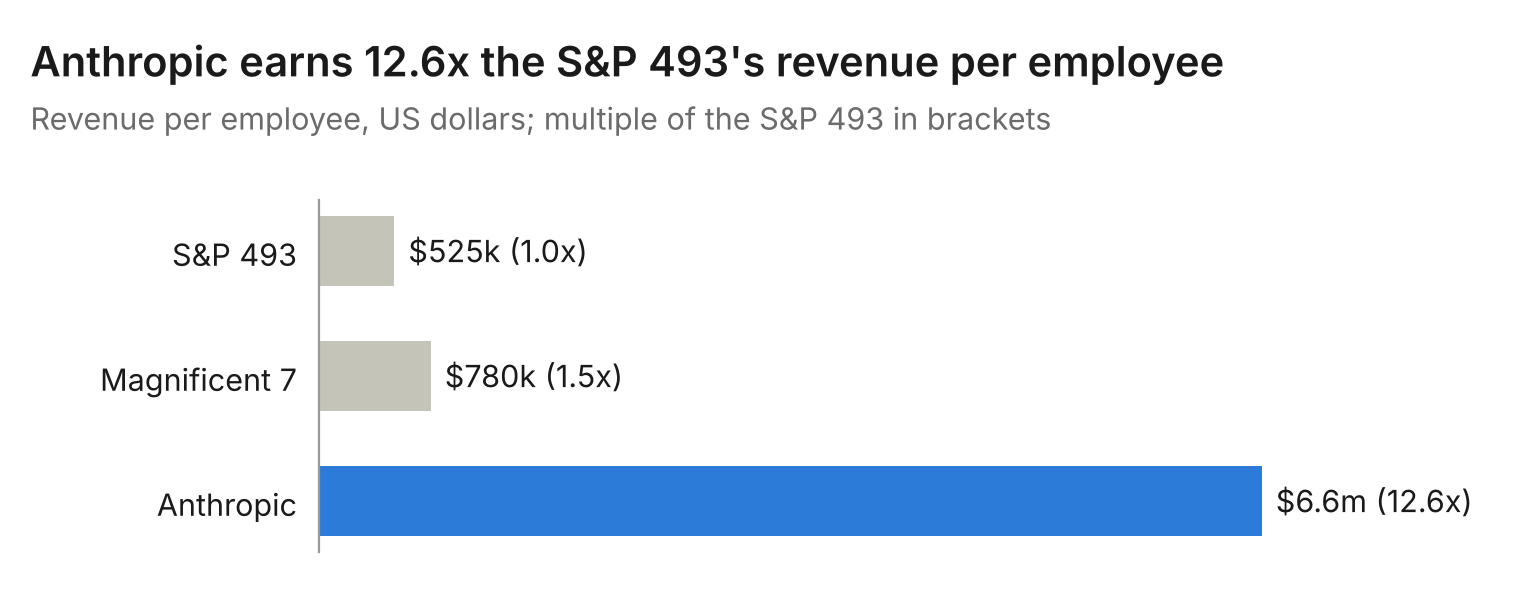
S&P 493 and Magnificent 7: Slok (Apollo), inflation-adjusted, via Stocktwits, 25 Oct 2026. Anthropic: S-1, trailing twelve months to 30 Sep 2026, nominal.
Anthropic's figure was $1.4 million a year earlier. The payoff Slok can't find is pooling with the sellers of intelligence.
The bull: cognitive mercantilism
Rao reads the panic through Joyce Appleby's history of capitalism. Mercantilists treated wealth as a fixed stock to hoard, ordinary people as labour to command, and demand as an afterthought. Swap wealth for intelligence and you have today's elite view of AI: scarce brains, guarded output, a mass of supposedly useless minds.
His evidence is the industrious revolution. Before the factories, English workers lifted their working year from roughly 250 days to 300, largely by choice, to buy tea, sugar, tobacco and Indian cottons. Demand moved first; the productivity gains followed.
Rao's claim for AI is the same: demand for intelligence grows as its price falls, with no obvious ceiling. "The returns on attention rise, and with them the incentive to pay attention." He notes that Claude Code and a Netflix subscription both cost about $20 a month. Households will choose.
Market reality: the S-1
Anthropic's filing is the clearest look yet inside a US frontier lab, and it reads like Rao's ledger. Revenue went from $41 million in 2023 to $4.6 billion in 2025, then $16.3 billion in the first half of 2026 alone. Second-quarter revenue grew 1,368% year on year; compute and infrastructure expense grew 300%.
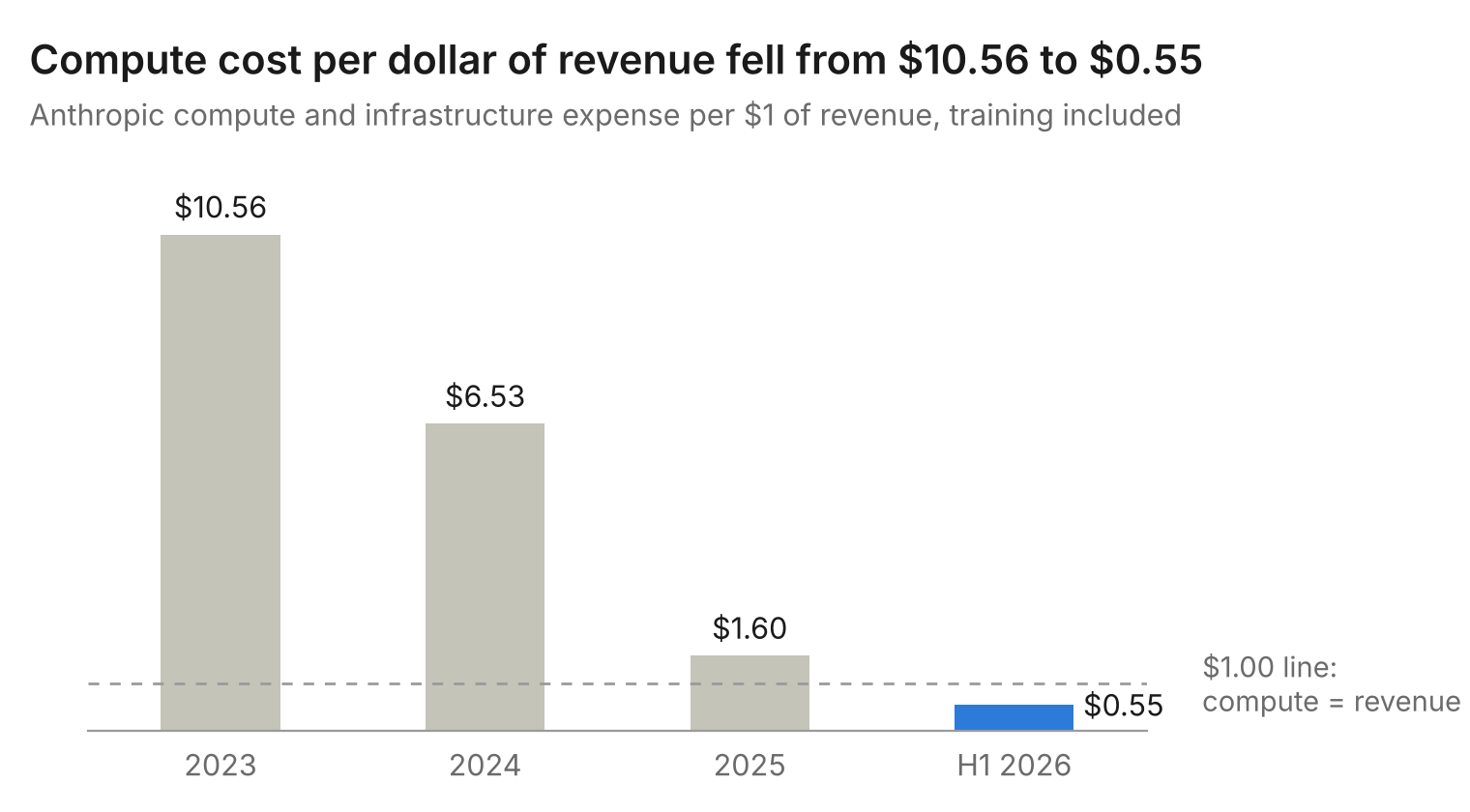
Anthropic S-1: compute and infrastructure expense divided by revenue, years ended 31 Dec 2023 to 2025 and six months ended 30 Jun 2026.
The figure counts training compute as well as serving. For the first time, revenue covers the whole compute bill with room to spare.
Cheaper intelligence bought more usage. Claude Opus 5.5 cut customer cost per task by about 40% against Opus 5, and net revenue retention sits near 900%. Adjusted operating margin reached 10% for the half; the GAAP operating loss was $693 million.
The headline $80.7 billion net loss is mostly a $72.4 billion fair-value charge on convertible notes, driven by Anthropic's own rising valuation. Anyone waving it as proof of a bubble is reading a mark-to-market.
Concentration is what rationing looks like
Slok reads his 99.5% as an absence of demand. The S-1 says Anthropic has sought compute from its cloud partners "in excess of what those partners were willing to provide." Scarce supply goes to the highest-value buyers first, and that allocation looks exactly like Slok's concentration.
NOOPS has logged the same ceiling at every layer of the stack. TSMC is sold out until 2028, and our line in March still stands: "It's good to be the most important business in infra." SK Hynix's chairman says it cannot meet memory demand until about 2030. Nvidia guides 70% growth against customers forecasting a doubling; our read in August took seven words: "they don't have enough RAM or fab."
AI companies now buy about 70% of the world's memory. Our line from the helium work covers the whole stack: "Photons and atoms are the ultimate basis of infra." At the median firm, the physical limit arrives as price. Uber burned its annual AI budget in four months, and a third of Australian organisations have paused or wound back on cost.
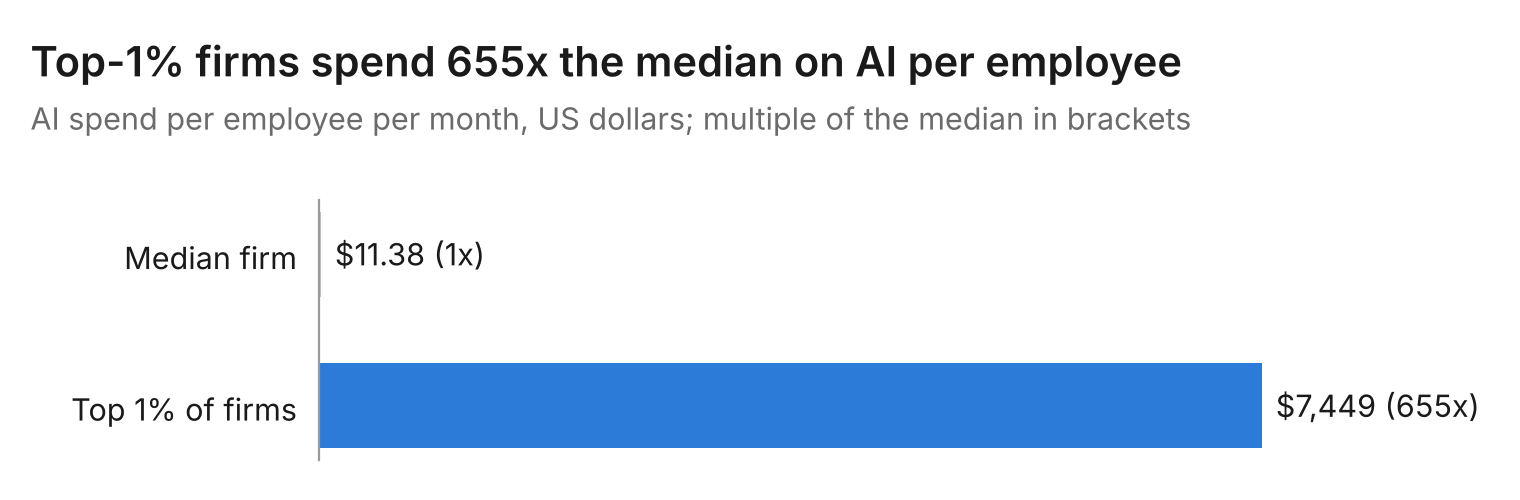
Ramp corporate card and bill-pay data, as logged in the NOOPS corpus, 2026.
The median firm's bar is under a pixel wide. That is a firm waiting in the queue.
Slok's sharpest number, 80.4% of top spenders venture-backed, matters less under rationing. Every token produced finds a buyer.
The pudding's clock
Slok's test is the right test at the wrong time. The S&P 493 decides the story once supply stops rationing who gets to buy, and that is a 2030s event. TSMC's first High-NA volume node lands around 2029 to 2030, and no Intel and SK Hynix memory fab in Ohio produces a wafer before 2029.
Anthropic has bet its balance sheet on what happens next, with compute commitments running to 2045. Rao is the case that his demand will be waiting when the ceiling lifts. So far nothing has outrun demand growth: every efficiency gain has been absorbed, and then some.
Whether Anthropic earns a margin in a contested inference market is a separate question; we have warned that a reseller of intelligence is caught "between a falling revenue line and a rising input line." On the macro, one signal would change our view: GPU rental and memory spot prices falling while utilisation drops. Through 2026, both point the other way. Until they turn, the pudding says what Norman Lindsay's always said. Cut and come again.
Postscript
On Friday 11 December, NOOPS walks the whole stack at AI Investor Sydney: six evidence-led briefings on materials, energy, semiconductors and data centres, models, harnesses and applications, then lunch with the speakers. Slok can keep the dirt. We've booked the Gold Melting Room at The Mint, where colonial gold was turned into currency.
Super Early Bird tickets are $995 until 30 October and include twelve months of NOOPS Pro. Seating is genuinely limited. Register here.
Analysis and education only. Not financial advice.
Sources
- Anthropic, PBC, Form S-1, filed 26 October 2026
- Apollo's Torsten Slok warns AI has delivered zero financial payoff outside tech, Stocktwits via Yahoo Finance, 25 October 2026
- Venkatesh Rao, "Cognitive Mercantilism", Contraptions, 25 October 2026
- NOOPS signal corpus, March to October 2026